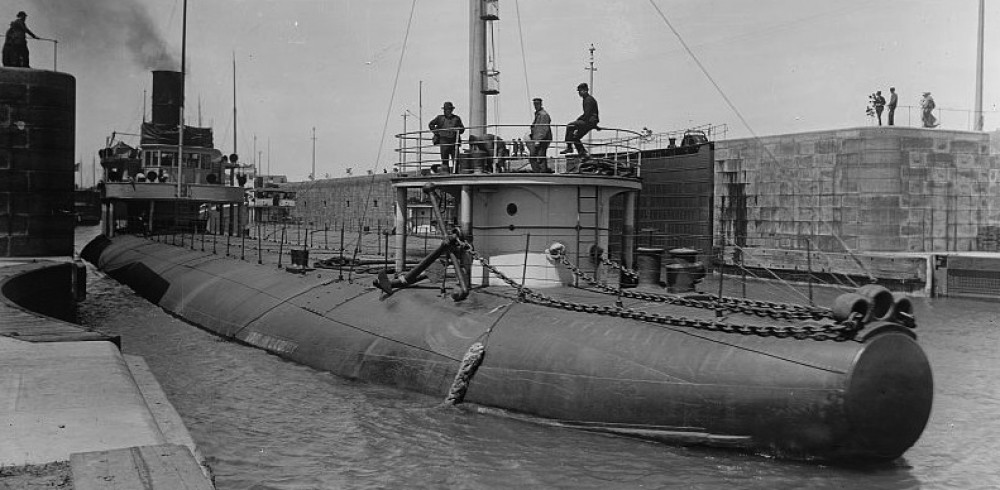
Tied to a current editing project I’m working on, the issue of ballast in whalebacks is particularly ignored.
Maintaining stability while loading and underway requires a delicate dance of water ballast and cargo. Whalebacks had a particularly ingenious system that offered good intake and output without the dangers of the “free-surface” effect that plagued so many ships such as the Eastland.
 McDougall's Whaleback
Can you tell us a bit about the ballast system the whalebacks had and what the “free-surface” effect is?
The whalebacks, particularly after Barge 104 had a relatively sophisticated system of piping, tanks, and intakes to add water within the double-bottom of the hull. That allowed for more precise trimming of the vessel, particularly when light without cargo. For early steel vessels, they often had pretty limited systems, the whalebacks being conceptualized from the keel up, had it built in.
The free surface effect is similar to walking with a pan of water. It sloshes around and then spills as it doesn’t follow a predictable path. The larger the surface area, the greater the free surface effect. Think of an ice cube tray, and the water within the little divided sections stays relatively put. Ballast tanks need partitions that prevent the water from sloshing inside the hull a dangerous situation that can cause the ship to heel dangerously to one side or the other. Such a situation caused the passenger ship the Eastland to capsize in Chicago. At the same time, you can’t make the partitions in such a way that the water doesn’t fill and drain appropriately.