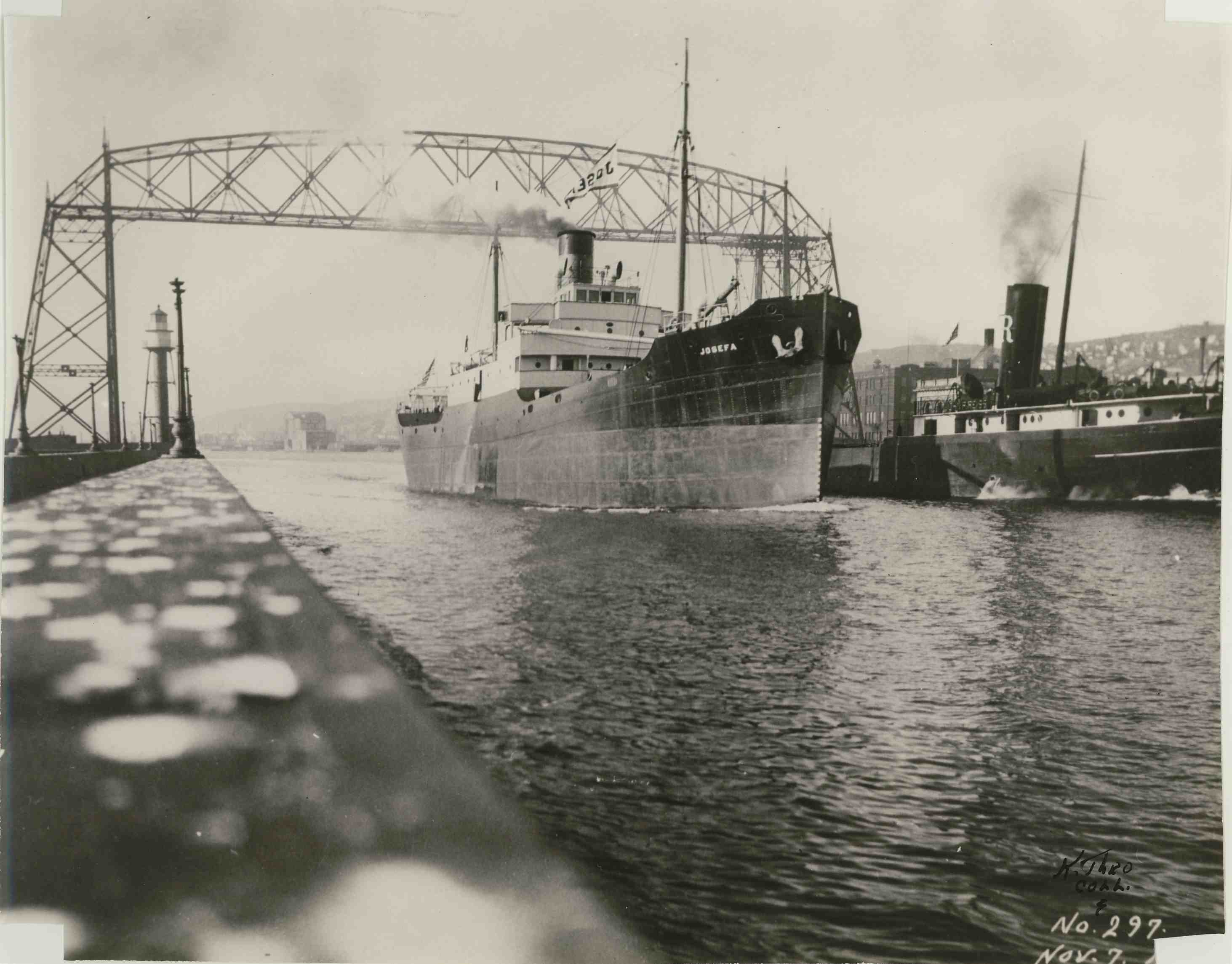
Josefa departing Duluth on Monday, November 8, 1920 at 1:30 p.m.
Photo from the Fr. Edward J. Dowling, S.J. Marine Historical Collection, University of Detroit Mercy
The abrupt end of the First World War in November 1918 left the United States’ shipbuilding industry in a rather large quandary. Though the United States Shipping Board honored the contracts already on the books, it certainly meant the end of the lucrative contracts enjoyed by the “pop-up” companies who had rushed to fill the void. Some of these had provided vessels of indifferent build quality, while others had engaged in outright graft. The exorbitant contracts extended to all firms to pressure them to expand and build faster and in greater numbers also would plague the USSB until the 1930s. It also provided valuable lessons for the Second World War where contracts held different terms, and only a select number of shipyards built the famous Liberty and Victory ships.
The end of the war posed a serious challenge to the McDougall-Duluth Company and it’s Riverside shipyard. Unlike Globe Shipbuilding in Superior, Wisconsin, company president Julius Barnes had structured McD-D to last far beyond the war. Even before the end of the war, Barnes and A. Miller McDougall sought new contracts for the firm. Using the basic Frederickstadt design, the hull received linings to serve as tankers, notably for molasses in the lucrative Caribbean sugar trade. Five vessels were constructed on speculation in the hopes of attracting purchasers
Two were purchased for the Compania Contrabrino de Navegation of Barcelona, Spain, through a Belgian broker with cash not being an object. Problems started immediately when the Cuban sugar market crashed and the Spanish company struggled to find financing. Finally the financing came through, but to be certain the yard would send representatives to ensure a smooth transition. To great fanfare the Josefa and Antonio departed Duluth at 1:30 and 4:20 p.m. respectively on Monday, November 8, 1920. The vessels had Spanish crews with a few Americans under the command of the yard’s tugboat skipper, Captain D.E. Stevens, to take the vessels across the Atlantic for its new owners to take possession in Genoa, Italy. Upon reaching Montreal a new complication cropped up. The combination of an American supercargo seeking clearance of an American-flag vessel, manned by a Spanish crew, from a Canadian Port to an Italian destination was something of a problem.
Upon arriving in the Mediterranean the Spanish crew discovered that they were heading to Genoa instead of Barcelona and promptly filled the fresh water tanks with sea water forcing the Josefa into Barcelona. Having worked on an American-flag vessel, the crew demanded of Stevens the higher U.S. wage rate and mutinied by walking off the ship and appealing to the U.S. consulate. The remainder of the American crew, contracted only to get the vessel across the Atlantic, departed for home and left Stevens to man the ship. The ambassador left the matter to his staff, and after a lengthy period of wrangling it was found that the original purchasers could no longer pay for the ships. The McDougall-Duluth Company repossessed the vessels and managed to find a new purchaser in Barcelona. At long last, Captain Stevens could finally return home.
Josefa would be renamed and continue sailing throughout Europe, surviving both the Spanish Civil War and World War II until its 1964 scrapping in Spain.
 McDougall's Whaleback